Pro SWPPP – America’s #1 SWPPP Service has helped contractors nationwide turn stormwater compliance from a headache into a simple checkbox. Here’s the truth: if you’re moving dirt on a construction site, you probably need a plan. But is it a CBMPP or a SWPPP? And what’s the difference?
Agency: Alabama Department of Environmental Management (ADEM) ·
Permit: ALR100000 Construction General Permit (eff. 4/1/2026 – 3/31/2031) ·
Plan: CBMPP — Construction Best Management Practice Plan ·
Threshold: 1 acre, including common plans of development ·
Roles: a QCP prepares and certifies the plan (CPESC qualifies); a QCI performs site inspections ·
Filing: Notice of Intent submitted through AEPACS ·
Inspections: monthly, plus within 72 hours of any rain event over 0.75″ (5 days for linear projects)
Most contractors get confused because the terms sound the same. They both talk about stormwater. They both mention erosion control. But they’re not identical. One is a detailed construction guide. The other is a bigger compliance wrapper.
This guide will clear it up. We’ll explain what a CBMPP is, when you need one, and how it fits into your stormwater permit. You’ll walk away knowing exactly which paperwork your job site needs.
What Is a CBMPP?
CBMPP stands for Construction Best Management Practices Plan. It’s a site-specific document that tells your crew exactly how to prevent mud, dirt, and pollutants from washing into nearby streams, rivers, or storm drains.
Think of it as your field playbook. It shows where water flows on your site, what can pollute it, which Best Management Practices (BMPs) stop it, and who checks that everything is working.
In Alabama, the CBMPP must be prepared and certified by a Qualified Credentialed Professional. It’s not a fill-in-the-blanks template. It needs to match your site’s drainage, slopes, and construction sequence. For detailed Alabama rules, check out our Alabama SWPPP CBMPP requirements guide.
What Goes Inside a CBMPP
A proper CBMPP includes:
- Site narrative and construction phasing
- Disturbed acreage limits
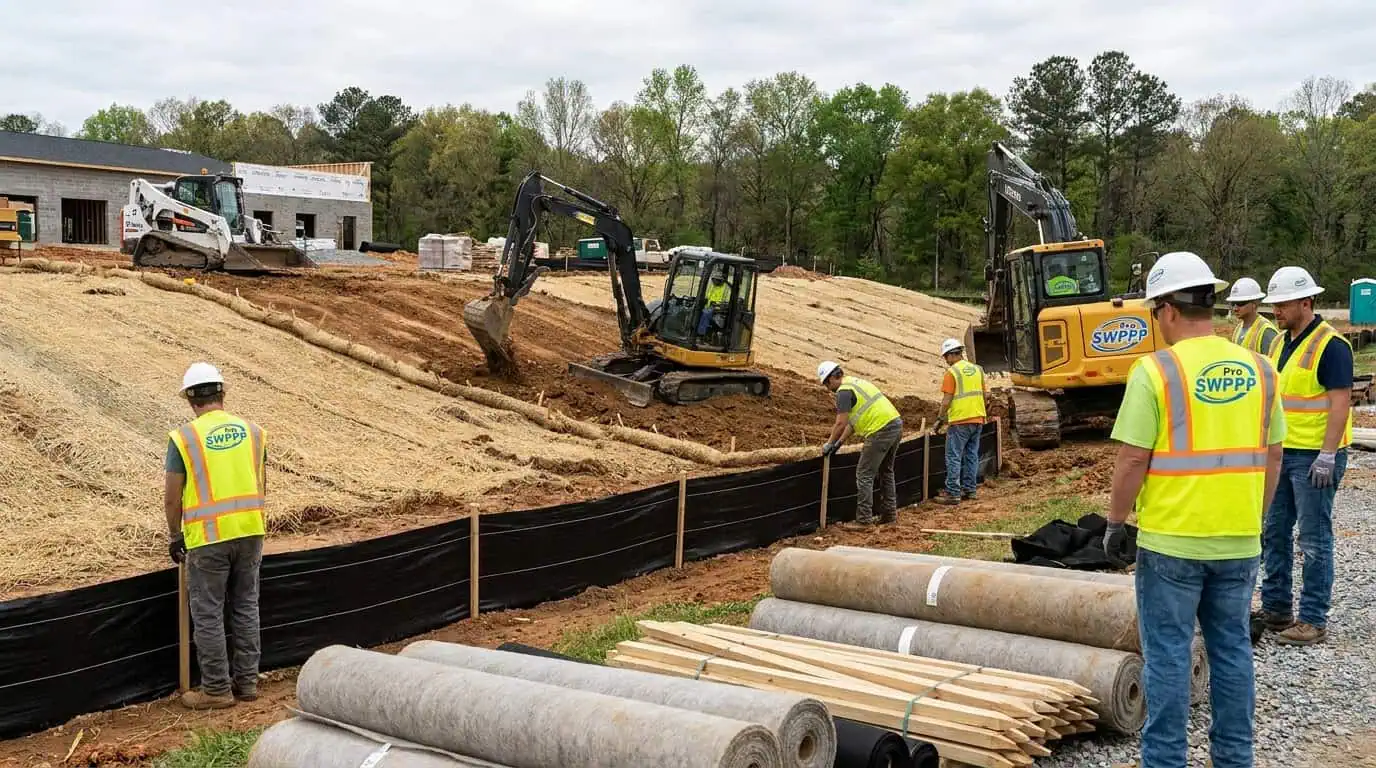
- Erosion control measures (slope protection, silt fence, inlet protection)
- Sediment control devices (basins, ditch checks, perimeter controls)
- Stabilized construction entrance details
- Waste handling and material storage plans
- Inspection schedules and documentation logs
- Special protections for priority waters or impaired streams
The plan must be updated whenever site conditions change. That means after storms, grading changes, or new phases of work. It’s a living document, not a one-time file.
CBMPP vs. SWPPP: What’s the Difference?
A SWPPP is a Stormwater Pollution Prevention Plan. It’s the broad compliance document required under the Clean Water Act’s NPDES program for construction sites that disturb one acre or more.
The CBMPP is the detailed backbone of BMP implementation. On some projects, the SWPPP and CBMPP are the same document. On others, the CBMPP lives inside the SWPPP as the technical section.
In Alabama, if your contractor-permitted project includes all required information in the CBMPP, you may not need a separate SWMP. But in most states, including Texas and Georgia, you’ll prepare a full SWPPP that covers inspections, monitoring, training, and contractor responsibilities.
When You Need a CBMPP
You need a CBMPP if:
- Your state requires a site-specific BMP plan as part of NPDES construction coverage
- You’re working on a DOT or state highway project
- Your contract documents call out CBMPP requirements
- You’re in Alabama or a similar state with explicit CBMPP rules
Check your Construction General Permit. It will tell you if a CBMPP is mandatory or if your SWPPP already covers everything.
Don’t want to mess with all the paperwork and requirements? Check out Order your SWPPP now with Pro SWPPP Professional CPESC Certified SWPPP Services.
Common Contractor Mistakes with CBMPPs
Using Generic Controls
A lot of contractors grab a template, fill in the blanks, and think they’re done. That’s a mistake. Alabama guidance says your plan must be tailored to your site’s drainage, slopes, and sensitive waters.
Generic language like “install silt fence as needed” won’t cut it. You need to show where the fence goes, how it ties into existing terrain, and who inspects it after rain.
Skipping Maintenance
Installing BMPs is step one. Maintaining them is step two. Sediment basins fill up. Silt fences tear. Inlet protection gets buried. If you don’t inspect and repair controls, they fail.
Your CBMPP should include a maintenance schedule and assign responsibility to a crew member. Most states require weekly inspections and after every rain event that’s half an inch or more.
Poor Recordkeeping
Inspections don’t count if you don’t document them. Keep logs of rainfall, BMP repairs, plan amendments, and spill observations. Field guidance recommends keeping records for at least three years after you terminate NPDES coverage.
In Alabama, the project QCP reviews the CBMPP every three months. That review should be logged and stored with your other project documents.
How Pro SWPPP Helps Contractors
Pro SWPPP – America’s #1 SWPPP Service prepares site-specific CBMPPs and SWPPPs that meet state and federal rules. Every plan is written by CPESC-certified professionals who understand erosion control, sediment basins, and permit language.
Site-Specific Plans
We don’t use generic templates. Every CBMPP is custom-built for your site’s topography, drainage patterns, and construction schedule. We review your grading plans, identify sensitive waters, and specify BMPs that actually work.
Fast Turnaround
Most plans are delivered in 2 to 5 business days. Need it faster? We offer rush service. You get a complete, inspection-ready document without waiting weeks.
Expert Support
Questions about inspections, amendments, or NOI filings? Our team is available by phone, email, or video call. You’re not just buying a PDF. You’re getting ongoing compliance support.

Not sure what your project needs? Take our SWPPP Quiz or Schedule a Free SWPPP Consultation with CPESC Certified SWPPP Expert Derek E. Chinners.
Key Compliance Concepts Every Contractor Should Know
NPDES and the Construction General Permit
The National Pollutant Discharge Elimination System is the federal permit program under the Clean Water Act. If you disturb one acre or more, you need NPDES coverage before you start dirt work.
Each state runs its own version of the Construction General Permit. The CGP sets the rules for stormwater discharges, inspection frequency, and BMP performance standards.
Erosion Control vs. Sediment Control
Erosion control keeps soil in place. Sediment control captures dirt that’s already moving. You need both. Erosion control includes mulch, tackifiers, and slope matting. Sediment control includes silt fences, basins, and inlet protection.
Your CBMPP should describe which controls go where and when they’ll be installed during construction phasing.
TCEQ in Texas
The Texas Commission on Environmental Quality oversees stormwater permits in Texas. TCEQ requires a full SWPPP, not just a CBMPP, for most construction sites. Your plan must cover pollution prevention, spill response, and post-construction controls.
Pro SWPPP prepares TCEQ-compliant SWPPPs that meet all state requirements. We know the rules and we write plans that pass inspections.
What Happens If You Skip the CBMPP?
If your state or contract requires a CBMPP and you don’t have one, you’re out of compliance. That can trigger:
- Stop-work orders
- Daily fines of $1,000 to $25,000 or more
- Loss of bonding or contractor license
- Liability for downstream pollution damage
Inspectors check for the plan during site visits. If you can’t produce a current, signed CBMPP, you fail the inspection. It’s that simple.
Don’t risk it. Get your plan done right the first time with Pro SWPPP – America’s #1 SWPPP Service.
FAQ
Do I need a CBMPP if I already have a SWPPP?
It depends on your state and contract. In Alabama, a detailed CBMPP can satisfy most SWPPP requirements. In other states, the CBMPP is part of the SWPPP, not a replacement. Check your Construction General Permit or ask your permitting authority.
Who can write a CBMPP?
In Alabama, the CBMPP must be prepared and certified by a Qualified Credentialed Professional. In other states, it’s best practice to use a CPESC or CESSWI-certified professional. Pro SWPPP employs certified experts who write compliant plans every day.
How often do I update my CBMPP?
Update it whenever site conditions change. That includes new grading, phasing, BMP failures, or spills. In Alabama, the QCP reviews the CBMPP at least every three months. Keep a log of all amendments.
What BMPs are required in a CBMPP?
It varies by site, but common BMPs include perimeter silt fence, inlet protection, stabilized construction entrances, sediment basins, slope protection, and dust control. Your plan should specify which BMPs are installed, where, and when.
Can I use a template CBMPP?
Templates are a starting point, but they’re not compliant on their own. Your CBMPP must be site-specific, with custom details about drainage, soils, slopes, and construction sequencing. Generic templates fail inspections.
How long do I keep CBMPP records?
Keep all inspection logs, rainfall data, and plan amendments for at least three years after you terminate NPDES coverage. Some states require longer retention. Store records digitally for easy access during audits.
Does Pro SWPPP prepare CBMPPs for all states?
Yes. Pro SWPPP serves contractors in Alabama, Texas, Georgia, and all 50 states. We write site-specific plans that meet local, state, and federal requirements. Visit our About page to learn more or contact us for a quote.
Ready to get started? Order your SWPPP now or schedule a free consultation with Pro SWPPP.
Visit Pro SWPPP and see why contractors nationwide rely on America’s #1 SWPPP Service.
More Alabama stormwater guidance
This guide is part of our Alabama compliance cluster. Start with the hub: Alabama SWPPP & CBMPP Services.
- Birmingham CBMPP Guide
- Montgomery CBMPP Guide for Contractors
- ALR100000 Guide
- CPESC Certified CBMPP Inspections
Need your Alabama CBMPP?
Pro SWPPP are the paperwork and permitting experts. CBMPP prepared by a CPESC-certified QCP and your Notice of Intent filed with ADEM through AEPACS — in 72 hours, or it’s free. Physical installation of BMPs is handled by your site contractor.