If you’re planning a construction project in South Carolina that disturbs 1 acre or more of soil, you’re staring down a very real problem: stormwater compliance. The state doesn’t mess around with this stuff. Miss the requirements and you’ll face fines, project delays, and headaches that could have been avoided.
Here’s the deal – South Carolina follows federal Clean Water Act rules through the National Pollutant Discharge Elimination System (NPDES) program. The South Carolina Department of Environmental Services (SCDES) runs the show here, and the permit you need is the 2026 NPDES Construction General Permit, SCR100000. It was issued February 27, 2026, took effect March 30, 2026, and runs through March 29, 2031. Any guide written against the 2021 permit is out of date.
SCR100000 asks for three things, not two: a Notice of Intent (NOI), a Comprehensive SWPPP (C-SWPPP) submitted with it and approved before you disturb soil, and a condensed On-Site SWPPP (OS-SWPPP) kept at the site.
When You Need a SWPPP in South Carolina
The rules are pretty straightforward. Any construction site that disturbs 1 acre or more needs both an NOI and a SWPPP. But here’s where people get tripped up. A site under 1 acre is also covered if it is part of a Larger Common Plan of Development or Sale that adds up to an acre or more – the trap that catches most residential and phased work. Separately, in the eight Coastal Zone counties (Beaufort, Berkeley, Charleston, Colleton, Dorchester, Georgetown, Horry and Jasper), SCR100000 also reaches disturbances of less than one acre within a half mile of a coastal receiving water, and those projects need a Coastal Zone Consistency determination from the SCDES Bureau of Coastal Management before the NPDES permit issues. Proximity to an impaired water is not by itself a coverage trigger in the permit.
Not sure which of those describes your site? Take the two-minute SWPPP Quiz and find out before you mobilize.
Industrial facilities have their own set of rules. If you run a facility that could discharge pollutants into stormwater, you likely need an industrial SWPPP regardless of size. Think manufacturing plants, airports, or large commercial operations.
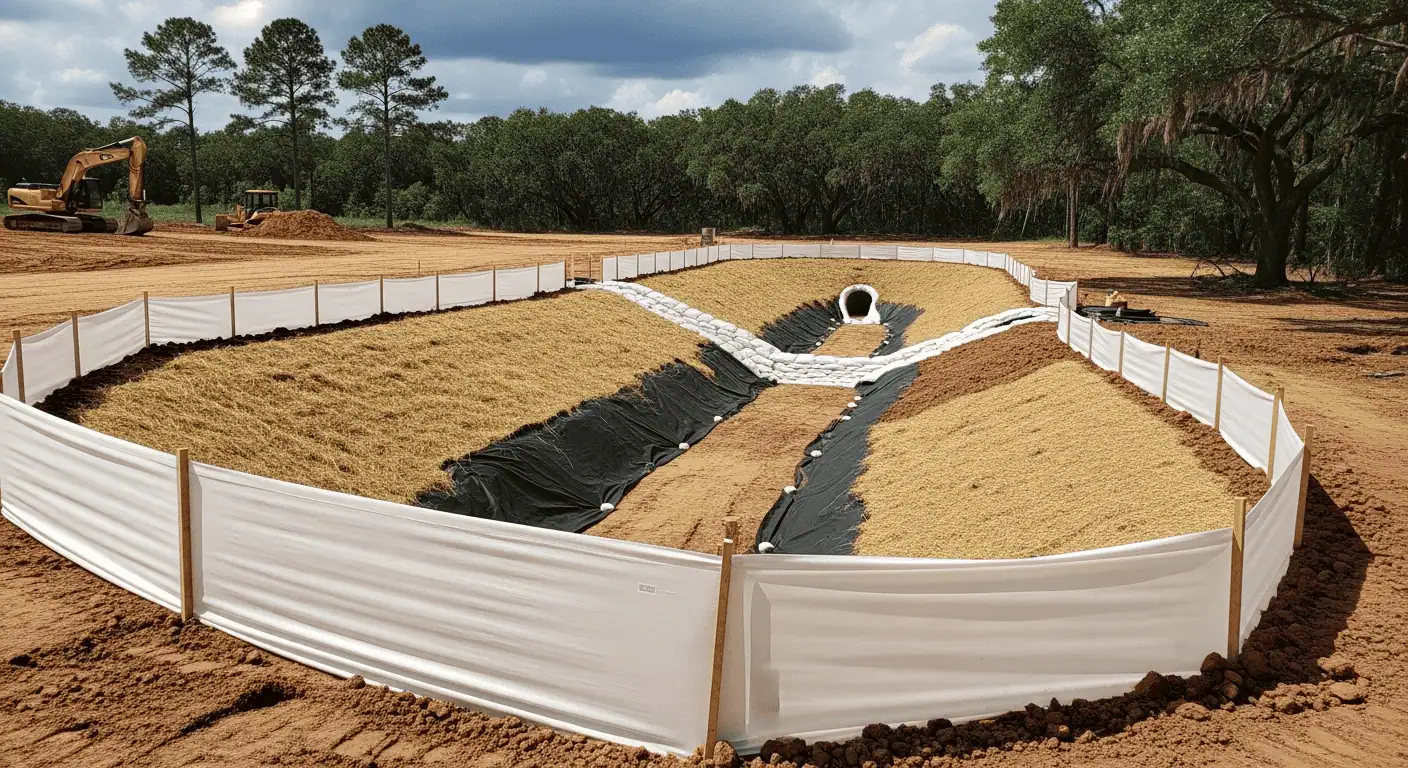
The Construction General Permit (CGP) covers most construction projects. Your SWPPP needs to include Best Management Practices (BMPs) for both Erosion Control and Sediment Control. This isn’t optional – it’s the law.
Two Types of SWPPPs You Need to Know About
South Carolina requires two versions of your SWPPP. First is the Comprehensive SWPPP (C-SWPPP). On a site disturbing more than 2 acres, Section 3.1.2.B requires it to be prepared, certified and stamped by a South Carolina-licensed professional – a registered professional engineer, a registered landscape architect, or a Tier B land surveyor. On sites of 5 acres or more falling under the SCDOT roadway standards, Section 3.1.2.C is stricter: a registered professional engineer licensed in South Carolina must prepare and seal it, and no other credential substitutes. In the Coastal Zone, sub-2-acre sites within a half mile of a coastal receiving water follow the same professional rule whenever runoff storage is required for water-quality treatment. It includes everything: project details, site maps, engineering reports, construction sequence, and all your erosion and sediment control plans.
Second is the On-Site SWPPP (OS-SWPPP). This is a condensed version that stays on your construction site. Inspectors need access to it. Under Section 3.1.6.B of the 2026 permit you may keep electronic copies, but the plan has to be produceable within 30 minutes of a request – and that applies on every site, not only linear ones. The OS-SWPPP includes your NOI, CGP coverage letter, local approvals, contractor certifications, and inspection logs.
Don’t want to mess with all the paperwork and requirements? Check out Order your SWPPP now with Pro SWPPP Professional CPESC Certified SWPPP Services.
The Notice of Intent Process
Before you can start any land disturbance, you need to submit your Notice of Intent through South Carolina’s ePermitting portal. You can’t just submit and start digging – you must wait for approval. This is where many contractors make costly mistakes.
The NOI tells the state about your project, when you plan to start, what BMPs you’ll use, and how you’ll prevent pollution. It connects your project to the statewide Construction General Permit – and it travels with your C-SWPPP, because Section 3.1.5.A requires that plan to be submitted for review and approved before construction activities may commence.
Who approves it depends on where you are building, and this is the part most guides get wrong. Approval comes from SCDES, from a regulated MS4, or from an entity delegated under Regulation 72-300 – it does not automatically come from the state. Roughly two dozen counties and municipalities run their own delegated review, and in Sumter County the reviewer is the Soil and Water district. SCDES publishes a Where to Apply table by county; confirm your reviewer before you file, because filing with the wrong office costs you the schedule.
The permit does commit to review clocks in Table 2-1: 7 business days where a regulated MS4 or a delegated entity reviews, and 20 business days where SCDES reviews the C-SWPPP itself. There is also a default-approval clause – if SCDES sends no letter authorizing coverage, denying coverage, providing review comments, or advising that a review will take place, authorization to discharge is automatically granted. In the Coastal Zone those clocks do not start until the Coastal Zone Consistency determination issues.
One more step nobody budgets for: Part 4.1 makes a pre-construction conference mandatory on every project with an approved OS-SWPPP, and every contractor, subcontractor and blanket utility has to attend. The 2026 permit relaxed the format – it can now be held virtually or off site unless your MS4 requires otherwise – but it still has to happen, and attendance has to be documented in the OS-SWPPP.
Inspection Requirements That Catch People Off Guard
Here’s where compliance gets tricky. Every covered site in South Carolina needs weekly inspections – not just sites over 2 acres. Part 4.2.B sets the frequency at least once every calendar week, with no period between inspections exceeding 9 days, running until final stabilization is reached on every area of the site. The 9-day outer bound is the number that shows up in a violation, so build your schedule to it rather than to a loose idea of weekly. These aren’t casual walk-throughs – Part 4.2.F lists fifteen mandatory elements for the report, including rainfall since the last inspection, items carried over unaddressed, and the date each prior corrective action was actually addressed.
The 2-acre line decides who may inspect, not whether you inspect. Above 2 acres, Part 4.2.E requires qualified personnel and gives four accepted routes: the preparer of the C-SWPPP; a person with an equivalent registration who is knowledgeable in the principles and practice of erosion and sediment controls; a person working under the direct supervision of someone qualified to prepare a C-SWPPP; or a person certified through a Construction Site Inspector Certification Course approved by SCDES. Clemson’s CEPSCI course currently satisfies that fourth route – but it is one option among four, and the permit never names it as a requirement. See our guide to SWPPP certification and qualified preparers for how the state credentials compare. At 2 acres or less, outside a local program, the permittee or a designee may inspect, provided the C-SWPPP preparer has walked them through the OS-SWPPP and the inspection requirements.
South Carolina has no mandatory rain-event inspection. Part 4.2.B recommends that BMPs be assessed within 24 hours of the end of a storm event of 1.0 inch or greater, and during the first rain event after BMPs are installed – recommended, not required, and it sits on top of the weekly duty rather than replacing it. South Carolina is not one of the states that lets you elect a longer routine interval in exchange for storm inspections. Separately, Part 4.2.D strongly recommends an on-site rain gauge recording any significant event of 0.5 inches or greater; that is a recordkeeping threshold, not an inspection trigger, and certified off-site weather-station data is accepted instead. Rainfall for the day of the inspection and for any significant event since the last one must appear on every weekly report.
Once an area reaches temporary or final stabilization you may drop to monthly inspections there, so long as stabilization holds and nothing new is disturbed. The catch worth knowing: if the whole site is finally stabilized but you never file the Notice of Termination, monthly inspections keep running. On linear projects, Part 4.2.C allows representative inspections – a quarter mile above and below each access point stands in for the reach to the next inspected segment. And SCDES can require more frequent inspections case by case, naming sites with compliance problems and sites discharging to Sensitive Waters.
Delegated local programs do add their own twist. Regulation 72-306.A lets a delegated agency set its own fees, and Part 4.1.C lets an MS4 impose stricter pre-construction terms, so a county’s rules can sit on top of the state baseline rather than mirror it. Greenville, Lexington, Richland, Horry, Charleston, Anderson, Pickens, York, Beaufort, Berkeley, Dorchester, Georgetown, Florence, Newberry, Darlington, Kershaw, Lancaster and Aiken all run delegated review, as do Moncks Corner, Fort Jackson, Shaw AFB and Joint Base Charleston. Never infer a delegated county’s requirements from the state permit alone – check the local program, because miss those requirements and the violation notices come fast.

Inspections continue until final stabilization is reached and you terminate your NPDES coverage, which often extends well beyond active construction. Note what final stabilization actually means here: a uniform vegetative cover at 70 percent of the natural background vegetative cover – not 70 percent of the bare ground in the absolute, which is how it is usually misquoted – or equivalent permanent measures such as landscaping mulch, riprap, pavement or gravel. On the way there, stabilization must be initiated immediately once earth-disturbing work has permanently ceased on an area, or has temporarily ceased and will not resume for more than 14 calendar days, with allowances for snow cover, frozen ground and drought.
Local Variations That Matter
State rules are just the starting point. Municipalities like Georgetown, Columbia, and Charleston often have additional requirements. These might include specific BMP standards, different inspection schedules, or unique reporting procedures.
Always check with local authorities before finalizing your SWPPP. What works in one county might not meet requirements in another. That is doubly true near Sensitive Waters – in South Carolina that term means Trout Waters, Outstanding Resource Waters and Shellfish Harvesting Waters – where SCDES may require more frequent inspections, and may require a qualified inspector even on a site of 2 acres or less that would otherwise be self-inspected.
Industrial vs Construction SWPPPs
Industrial SWPPPs run on a different permit and a different clock – they are living documents tied to ongoing operations rather than temporary controls for a build. If your facility is the question rather than your jobsite, start with the industrial SWPPP and MSGP guide, which owns that topic.
Construction SWPPPs focus on temporary controls during active building. Once the site reaches final stabilization and the Notice of Termination is filed, the construction obligation ends – but not before, which is why the termination step matters more than it looks.
Not sure what your project needs? Take our SWPPP Quiz or Schedule a Free SWPPP Consultation with CPESC Certified SWPPP Expert Derek E. Chinners.
Common Mistakes That Cost Money
The biggest mistake is treating your SWPPP like a one-time document. Site conditions change, weather happens, and BMPs need maintenance. Your SWPPP must reflect current conditions, not what you planned six months ago.
Another expensive mistake is assuming small projects are exempt. Even sub-acre sites can trigger requirements based on location and potential impacts.
Plan accessibility trips up many contractors. Your OS-SWPPP must be on site or produceable within 30 minutes of a request, and electronic copies are allowed. “It’s back at the office” doesn’t work when inspectors show up.
Why Professional Help Makes Sense
South Carolina requires licensed professionals to prepare C-SWPPPs for good reason. These documents involve complex engineering, regulatory knowledge, and local expertise. Getting it wrong costs way more than getting it right the first time.
Professional SWPPP services understand both state and local requirements. They know which BMPs work best for different soil types, slopes, and weather patterns. They also handle the ongoing updates and revisions that keep you compliant.
If you’re working in other states, similar professional services are available. We serve most of the United States with our SWPPP services.
What Does South Carolina Coverage Cost?
The permit fee is modest; the plan review is what scales. Section 2.3.3 of SCR100000 sets the coverage fee at $125 per request for coverage, governed by Regulation 61-30. Where SCDES reviews your C-SWPPP before granting coverage, an NPDES plan review fee of $100 per disturbed acre, capped at $2,000, is charged on top of it – so roughly $2,125 all in at the ceiling. A major modification review costs $100 plus $100 per acre of added disturbance, inside that same $2,000 project cap. A new owner taking over coverage pays the $125 with no second review fee, and carrying 2021 permit coverage forward into the 2026 permit costs nothing extra.
Two cautions. Regulation 72-306.B states that no fee is charged for land-disturbing activities of two acres or less where the Commission is the implementing agency, while the SCDES fee page bills $10 per tenth of an acre from the first tenth – the per-acre rate is identical, the floor is not, so confirm the number with your reviewer at filing. And in a delegated county, Regulation 72-306.A lets the local program set its own fees outright.
Filing is electronic only. SCDES no longer takes paper applications by mail or in person; everything goes through the ePermitting portal.
Want the number for your actual site instead of a range? Get a free SWPPP estimate – send us the acreage, the county and the project type and we will price it.
What Are the Penalties in South Carolina?
South Carolina runs two penalty regimes, and neither is the federal EPA figure quoted on most sites. SCR100000 points to the statutes directly. Civil penalties under S.C. Code Section 48-1-330 of the Pollution Control Act run up to $10,000 per day of violation for an NPDES permit violation, and criminal sanctions under Section 48-1-320 reach $25,000 for each day’s violation where a violation is willful, grossly negligent or reckless. Under the Stormwater Management and Sediment Reduction Act, Section 48-14-140 and Regulation 72-315 set a civil penalty of up to $1,000, with each day of a violation counting as a separate violation, and no penalty assessed until the violator has been notified. Falsifying a required record or tampering with a monitoring device carries its own $25,000 exposure under the permit.
SWPPP FAQs
How often are SWPPP inspections required in South Carolina?
Part 4.2.B of SCR100000 requires inspections at least once every calendar week, with no period between inspections exceeding 9 days, until final stabilization is reached on all areas of the site. That applies to every covered site, not only sites over 2 acres. Assessing BMPs within 24 hours of a storm of 1.0 inch or greater is recommended, not required, and it does not replace the weekly inspection.
Does South Carolina require a CEPSCI or CPESC certified inspector?
No. Neither certification is named as a requirement anywhere in SCR100000. On sites disturbing more than 2 acres, Part 4.2.E requires qualified personnel and accepts four routes: the preparer of the C-SWPPP, a person with an equivalent registration who is knowledgeable in erosion and sediment controls, a person under the direct supervision of someone qualified to prepare a C-SWPPP, or a person certified through a Construction Site Inspector Certification Course approved by SCDES. Clemson’s CEPSCI course currently satisfies that fourth route. At 2 acres or less the permittee or a designee may inspect after the plan preparer has walked them through it.
Who can prepare a SWPPP in South Carolina?
On a site disturbing more than 2 acres, Section 3.1.2.B requires the Comprehensive SWPPP to be prepared, certified and stamped by a South Carolina registered professional engineer, a registered landscape architect, or a Tier B land surveyor. On sites of 5 acres or more under the SCDOT roadway standards, Section 3.1.2.C requires a registered professional engineer licensed in South Carolina to prepare and seal it. The condensed On-Site SWPPP may be prepared by others but must follow the approved C-SWPPP.
Who approves a South Carolina SWPPP, and how long does it take?
Section 3.1.5.A requires the C-SWPPP to be approved before construction activities may commence, by SCDES, by a regulated MS4, or by an entity delegated under Regulation 72-300. Table 2-1 of the permit gives 7 business days where a regulated MS4 or delegated entity reviews and 20 business days where SCDES reviews the plan itself. If SCDES sends no letter authorizing coverage, denying coverage, providing comments, or advising that a review will take place, authorization to discharge is automatically granted.
What does a South Carolina construction stormwater permit cost?
Section 2.3.3 sets the coverage fee at $125 per request for coverage. Where SCDES reviews the C-SWPPP before granting coverage, a plan review fee of $100 per disturbed acre applies on top, capped at $2,000, so roughly $2,125 at the ceiling. Delegated local programs may set their own fees under Regulation 72-306.A, so confirm the figure with whichever office reviews your project.
When does a site under one acre still need a SWPPP in South Carolina?
When it is part of a Larger Common Plan of Development or Sale that totals one acre or more, and separately when it sits within a half mile of a coastal receiving water in one of the eight Coastal Zone counties: Beaufort, Berkeley, Charleston, Colleton, Dorchester, Georgetown, Horry and Jasper. Coastal Zone projects also need a Coastal Zone Consistency determination before the NPDES permit issues. Proximity to an impaired water is not by itself a coverage trigger in the permit.
South Carolina stormwater compliance doesn’t have to derail your project timeline or budget. Understanding when you need an NOI versus a SWPPP – and getting professional help to handle both correctly – keeps your project moving forward legally and efficiently. Pro SWPPP is America’s #1 SWPPP service, ready to handle all your South Carolina stormwater compliance needs at the drop of a hat.
A Quick Word About SCDES 🌴
South Carolina runs its construction stormwater program through SCDES (South Carolina Department of Environmental Services) under the NPDES Construction General Permit. South Carolina just reshuffled its environmental agency into SCDES — so half the old guides point you to the wrong office. Notices of Intent, fees, inspection logs, and a review queue that’s in no particular hurry — miss a step and your start date slides.
You came to build, not to babysit a state portal. One thing to be straight about, because plenty of pages get it wrong: South Carolina does not require a CPESC. What SCR100000 requires is a registered professional engineer, landscape architect or Tier B land surveyor to prepare and stamp the C-SWPPP above 2 acres, and one of four accepted qualification routes for whoever performs the inspections. Derek is a CPESC, which is why we stand behind what we write – but we are not going to sell you a credential your permit never asked for. Pro SWPPP handles the rest – the South Carolina SWPPP, the NOI, the SCDES filing and the weekly inspection program, coordinated with the licensed professional whose seal the permit calls for. Done in 72 hours, with 24-hour expedited turnaround when you’re against the clock. You break ground; we battle the bureaucracy.
Already hold coverage under the 2021 permit? Section 3.1.1.F of the 2026 CGP requires every SWPPP tied to an un-terminated approval under the previous permit to be updated to the 2026 permit. Coverage itself continues automatically with no new fee, but SCDES may at its discretion ask you to confirm your intent to be covered – and if you do not respond within 30 calendar days of that written request, coverage terminates and you start over with a new NOI, a new C-SWPPP and new fees, with all work except stabilization halted. If you have a 2021-era SWPPP sitting in a job trailer, that is the thing to deal with this month.
Let SCDES Be Our Problem, Not Yours.
Your South Carolina SWPPP, the SCDES filing and your weekly inspection program — done for you in 72 hours, 24-hour rush available, or it’s FREE.
✅ Order Your South Carolina SWPPP — The Easy Way →
📞 Talk to THE SWPPP Authority →
Schedule a call with Derek E. Chinners — Founder & Stormwater Consultant, CPESC · 833-GET-SWPPP
By Derek E. Chinners, CPESC — Founder & Stormwater Consultant, Pro SWPPP, LLC