In Colorado you cannot legally break ground on a one-acre site until CDPHE has sent you written notification that your permit coverage was granted. Filing the application is not the finish line. Starting work before that letter arrives is a violation on day one, and it is the most common way Colorado projects get shut down.
Here’s what most people don’t know: whether you need a SWPPP depends on where you’re building and how much dirt you’re moving. Get it wrong, and Colorado can assess up to $66,895 per day, per violation under C.R.S. 25-8-608(1), as adjusted by Regulation 101 effective May 30, 2026.
Let me break this down for you. No confusing legal talk. Just straight facts.
What Is a SWPPP and Why Colorado Cares
A Stormwater Pollution Prevention Plan (SWPPP) is your blueprint for keeping mud, chemicals, and debris out of Colorado’s rivers and streams. The Clean Water Act requires it. The EPA enforces it. And Colorado takes it seriously.
Think of it like this: when it rains on your construction site, all that dirty water has to go somewhere. Without a plan, it flows straight into the nearest waterway. That’s illegal under the National Pollutant Discharge Elimination System (NPDES) program.
The Colorado Department of Public Health and Environment (CDPHE) handles permits in the state through its Water Quality Control Division. Colorado is an authorized NPDES state, so CDPHE writes and enforces its own permit rather than running EPA’s.
Not sure whether your Colorado site crosses the threshold? Take the 60-second SWPPP quiz.
Do You Need a SWPPP in Colorado?
Simple answer: if you’re disturbing 1 acre or more of land, yes. But here’s where it gets tricky.
You also need one if your project is smaller than 1 acre but connects to a larger development that totals 1 acre or more. So that half-acre parking lot? If it’s part of a 2-acre shopping center, you need a SWPPP.
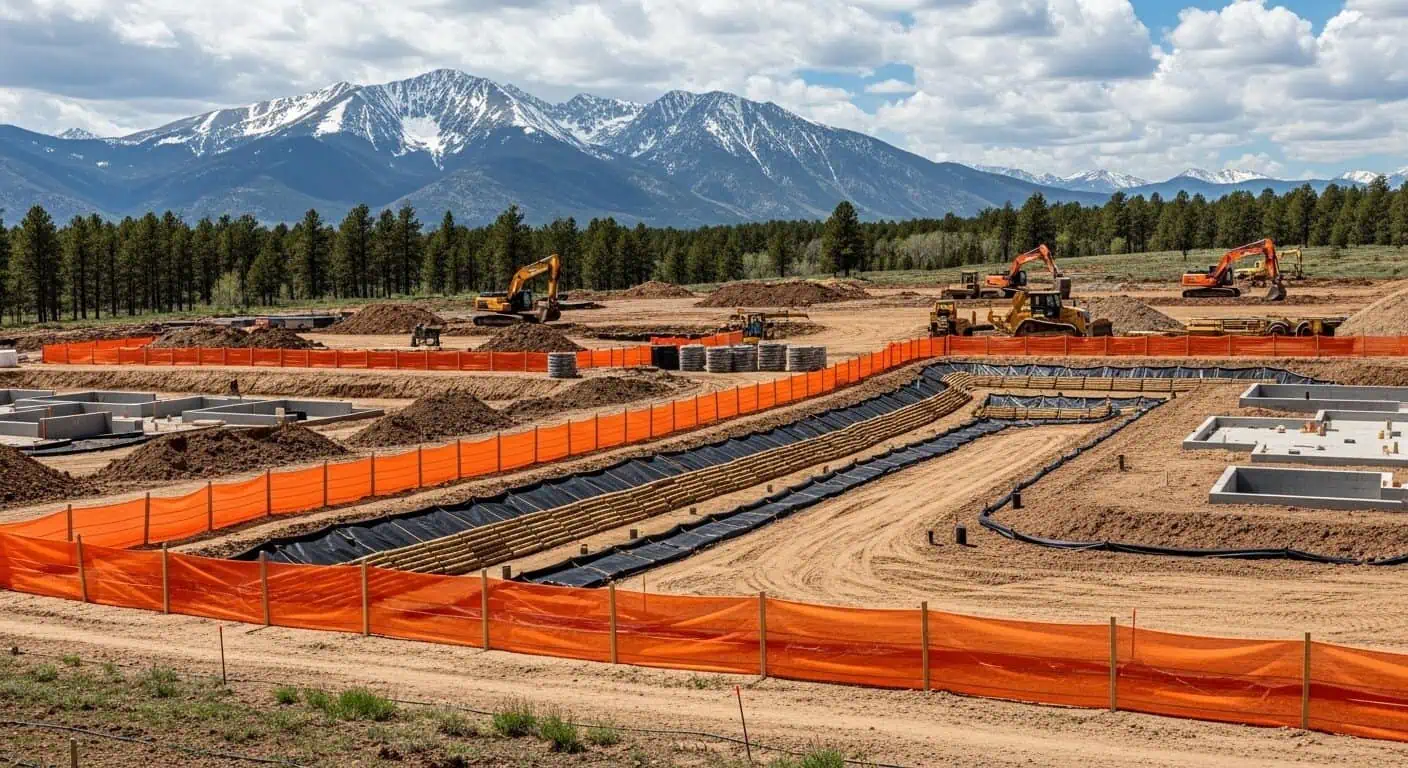
Colorado requires these documents before you break ground:
- Construction General Permit (CGP) from CDPHE
- SWPPP document with Best Management Practices (BMPs)
- Inspections every 7 calendar days, or every 14 calendar days if you also inspect within 24 hours after any precipitation or snowmelt event that causes surface erosion (COR400000 Part I.D.2)
- Erosion Control measures
- Sediment Control systems
Industrial facilities do not use EPA’s Multi-Sector General Permit in Colorado. Because Colorado is an authorized NPDES state, non-extractive industrial sites take CDPHE’s own COR900000 Industrial Stormwater General Permit instead. EPA’s MSGP reaches only Indian country within the state (COR05I000) and federally operated facilities (COR05F000). Our industrial SWPPP and MSGP guide covers the federal side.
Don’t want to mess with all the paperwork and requirements? Check out Order your SWPPP now with Pro SWPPP Professional CPESC Certified SWPPP Services.
Notice of Intent: Your First Step
Before you can get a SWPPP, you need to file a Notice of Intent (NOI). This tells Colorado you’re planning to disturb soil and need permit coverage.
The application includes basic project info: location, size, type of work, and your contact details. Both the owner and the operator must sign it, and both become permittees responsible for compliance. Submit it at least 10 days before construction starts (COR400000 Part I.A.3). Sites responding to a public emergency are the one exception; they apply within 14 days after work begins.
Here is the part most guides get wrong. Coverage in Colorado is not automatic. Within 10 days of receiving your application, CDPHE may issue a certification of coverage, request more information, delay the authorization pending further review, add terms and conditions, or deny coverage outright. You must receive written notification that the division granted permit coverage before you disturb any soil.
Colorado’s Special Requirements
Colorado isn’t like other states. The weather changes fast. You might get a sunny morning and a thunderstorm by lunch. These high-intensity storms can wash away BMPs that work fine in other places.
That’s why Colorado projects often need oversized BMPs. Your silt fence that works great in Georgia? It might not cut it here. For comparison, check out Georgia’s SWPPP requirements to see the difference.
Colorado also puts stabilization on a tight clock. Temporary stabilization is required wherever ground-disturbing work has permanently ceased, or temporarily ceased for more than 14 calendar days — tarps, soil tackifier, hydromulch. You may exceed 14 days only when the area has to stay disturbed to function, or when terrain and climate prevent stabilization, and only if your plan documents the constraint, states the alternate schedule, and maps every location it applies to.
Final stabilization by vegetation means evenly distributed perennial cover equal to 70 percent of what native vegetation would provide on a local undisturbed area or reference site. That is not 70 percent absolute ground cover, which is the detail most guides get wrong. Pavement, concrete, hardscape, xeriscape and stabilized driving surfaces all count as permanent stabilization with no percentage attached.

Common Mistakes That Cost Money
Here’s what trips up most contractors in Colorado:
- Choosing the 14-day schedule and then skipping the 24-hour post-storm inspections that come with it
- Using BMPs sized for other climates
- Not updating the SWPPP when conditions change
- Forgetting secondary containment for chemicals
- Missing maintenance on existing BMPs
That last one is huge. Your erosion control blanket works great in month one. By month six, it’s falling apart. Keep using it, and you’re asking for a violation.
What This Costs You
Colorado’s civil penalty maximum is $66,895 per day, per violation. The number comes from C.R.S. 25-8-608(1), which the Water Quality Control Commission re-indexes to Denver-area CPI; Regulation 101 set the current figure effective May 30, 2026. Anyone quoting you the $54,833 statutory base, or an old $10,000, is reading a stale source.
Criminal exposure is separate and stacks: up to $25,000 per day for criminally negligent or reckless pollution, and up to $50,000 per day plus prison for knowing or intentional violations (C.R.S. 25-8-609). On federal referral, judicial penalties run to $68,445 per day under 40 CFR 19.4.
The permit fees themselves are small by comparison. Regulation 102 Table C sets the annual construction stormwater fee at $165 under one acre, $350 from one acre to under 30 acres, and $540 at 30 acres or more. You are invoiced 50 percent of the annual fee when you apply, then the full annual fee every July 1 until you terminate coverage — so file your termination as soon as you hit final stabilization, because the annual fee is flat and is not prorated.
A basic SWPPP costs way less than one fine. Smart contractors budget for this upfront. The ones who don’t? They learn the hard way.
States like Texas have similar rules but different enforcement styles. If you work across state lines, check out Texas stormwater solutions to see how it compares.
Want a number before you commit? Get a free SWPPP estimate — send us the acreage and the county and we will price your Colorado plan.
New Trends in Colorado Stormwater Systems
Colorado cities are getting smarter about stormwater. Denver is pushing green infrastructure hard. They want to capture and reuse stormwater instead of just controlling it.
This changes how you design BMPs. The old way was “keep it out of the river.” The new way is “capture it and use it.” More complex but better for everyone.
One Colorado-specific rule to know before you pick a schedule: sites discharging to a water body the Water Quality Control Commission has designated an Outstanding Water get no choice at all. Inspections are mandatory every 7 calendar days under Part I.D.3. Check your receiving water first.
Getting Help for Acquiring a SWPPP
You have two choices: do it yourself, or hire experts. DIY saves money upfront but costs more if you mess up. Experts cost more now but prevent expensive mistakes.
Most smart contractors pick experts. The rules change too fast to keep up unless this is your full-time job. Want to learn more about professional services? See how we help.
Need a price for your specific site? Request a free Colorado SWPPP estimate.
Frequently Asked Questions
Does CDPHE approve your Colorado stormwater management plan?
No. There is no plan-approval step in Colorado, and the permit says only that the division may review the plan. What CDPHE approves in writing is your permit coverage, and it has 10 days from receipt of a complete application to do that. Submit at least 10 days before you intend to break ground, and leave buffer: if CDPHE requests more information or delays the authorization pending further review, you wait.
Can I start construction while waiting for Colorado permit coverage?
No. You cannot disturb any soil until your permit coverage is active. Starting early means automatic violations and potential project shutdown.
What happens if it rains before my BMPs are installed?
You’re liable for any pollution that occurs. Install temporary BMPs first, then upgrade to permanent ones. Never leave disturbed soil unprotected.
Do I need different BMPs for winter construction in Colorado?
Yes, and Colorado writes it into the permit. Part I.D.4 suspends inspections entirely, including the 7-day, 14-day, monthly and post-storm ones, where construction is temporarily halted for the winter season, snow cover exists over the entire site for an extended period, and melting conditions posing a risk of surface erosion do not exist. You must document the dates snow cover existed, the date construction ceased, and the date melting conditions began. That exclusion is written for high-elevation sites that genuinely stay frozen; a Front Range site that thaws midweek does not qualify.
How often do I need to update my SWPPP?
Update it whenever site conditions change significantly. New phases, different BMPs, or weather damage all require updates. Keep it current or face violations.
Pro SWPPP is America’s #1 SWPPP service, helping contractors nationwide stay compliant – get your professional SWPPP by using our services today.
A Quick Word About CDPHE 🏔️
Colorado runs its construction stormwater program through CDPHE (the Department of Public Health & Environment) and its Water Quality Control Division, under permit COR400000, which took effect April 1, 2024 and expires at midnight March 31, 2029. Those dates appear only on the permit PDF cover, not on CDPHE’s landing page, which is exactly why so many guides online still quote the retired 2019-2024 permit. The program rules live in 5 CCR 1002-61, the Colorado Discharge Permit System Regulations, last amended effective December 31, 2025; the plan contents themselves sit in the permit at Part I.C.2, not in the regulation. Fees moved out of the Water Quality Control Act and into Regulation 102.
One terminology note that catches out-of-state contractors: COR400000 never uses the word SWPPP. Colorado calls the document a stormwater management plan, or SWMP. It is the same deliverable, but write SWMP on anything you hand to CDPHE or a local reviewer.
You came to build in the Centennial State, not to decode CDPHE’s latest permit rewrite. Pro SWPPP handles all of it — your Colorado stormwater management plan, the CDPHE application and certification, and a CPESC-prepared document — done in 72 hours, with 24-hour expedited turnaround when you’re against the clock. You break ground; we handle the state.
To be straight with you about the credential: Colorado names no certification requirement at all. COR400000 requires a “Qualified Stormwater Manager,” and the permit defines that as nothing more than an individual knowledgeable in the principles and practices of erosion and sediment control with the skills to assess site conditions. No CPESC, no CESSWI, no state-approved course, no exam. You name that person in your plan and they sign every inspection report, which means you carry the risk if CDPHE disagrees with your pick. Our CPESC is how we take that risk off your desk, not a box Colorado makes you check. For how the credentials actually compare, see our SWPPP certification guide.
Let CDPHE Be Our Problem, Not Yours.
Your Colorado stormwater management plan, the CDPHE application and certification, and a CPESC-prepared document — done for you in 72 hours, 24-hour rush available, or it’s FREE.
✅ Order Your Colorado SWPPP — The Easy Way → 📞 Talk to THE SWPPP Authority →
Schedule a call with Derek E. Chinners — Founder & Stormwater Consultant, CPESC · 833-GET-SWPPP
By Derek E. Chinners, CPESC — Founder & Stormwater Consultant, Pro SWPPP, LLC
Related: What is a SWPPP? · When is a SWPPP required? The 1-acre rule and common plans · Colorado’s 1-acre threshold · Colorado SWMP requirements under COR400000 · SWPPP inspection frequency and who can perform them