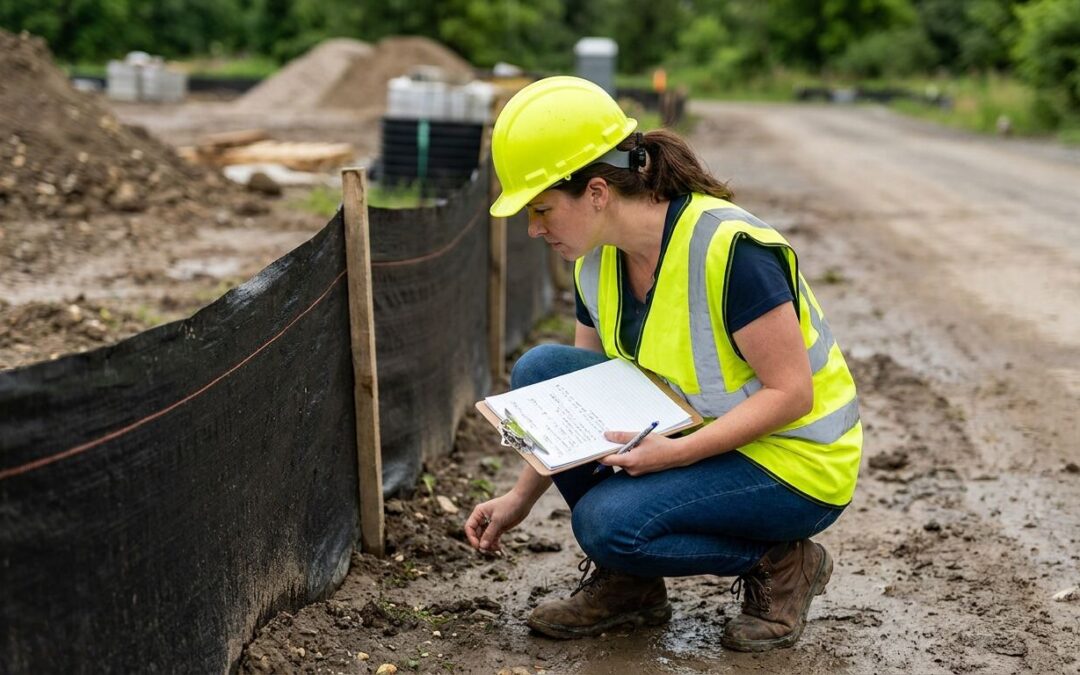
SWPPP inspection services operate under the permit authority applicable to each project. EPA's 2022 Construction General Permit applies only where EPA remains the permitting authority; most states administer their own construction-stormwater programs with distinct inspection schedules, rainfall triggers, and documentation rules that qualified personnel must follow.
Pro SWPPP prepares stormwater plans for contractors nationwide.
Not sure whether your project needs a SWPPP? Take the SWPPP quiz.
What does qualified SWPPP inspection mean across different permit jurisdictions?
A qualified SWPPP inspector meets the training, experience, or credential requirements established by the permit authority governing the project. The term does not refer to a single nationwide credential; instead, it reflects compliance with the specific qualifications mandated by EPA or the state agency with jurisdiction over the site.
Under EPA's 2022 Construction General Permit, the inspector must be a qualified person as defined in the permit. The EPA CGP permits the inspector to be an employee or a hired third party. States that administer their own construction-stormwater programs may impose additional or different training requirements, such as completion of a state-approved course, professional certification, or documented field experience.
There is no universal inspector credential recognized in every state. Each permit authority establishes its own qualification framework. A service operating in multiple jurisdictions must employ or contract with personnel who satisfy the applicable standard in each location where work is performed.
How do SWPPP inspection requirements differ between EPA and state permits?
EPA's 2022 Construction General Permit and state-administered permits impose distinct inspection schedules, rainfall triggers, and documentation timelines. Services must operate under the permit authority applicable to each project, not under one uniform national rule.
The 2022 Construction General Permit covers eligible construction stormwater discharges in EPA-authorized jurisdictions. It requires inspections during normal working hours at least every 7 calendar days, or every 14 days plus an inspection within 24 hours of specified qualifying events, subject to additional requirements and permitted reductions. EPA requires inspection of unstabilized cleared, graded, or excavated areas and all installed stormwater controls. Inspectors must evaluate whether controls are installed, operational, and effective; identify spill or pollutant risks; and determine whether new or modified controls are needed. An inspection report must be completed within 24 hours after each inspection, retained for at least 3 years after permit coverage expires or terminates, and made available at the site or an accessible location.
One figure is worth pinning down, because it is quoted wrong more often than any other: under the 2022 CGP the post-storm trigger is a storm event producing 0.25 inches or more, not the 0.5 inches carried in the superseded 2017 permit. The 7-day and 14-day-plus-event schedules are set out in full in our guide to SWPPP inspections every 7 days or after quarter-inch rain. Several state permits genuinely do use 0.5 inches, which is precisely why the federal number cannot be carried onto a state-permitted site.
EPA remains the permitting authority in only some states, territories, and much of Indian Country. Authorization status must be checked for the specific project jurisdiction.
State requirements are not uniform and must be verified from the applicable state permit, authorization, and current agency guidance. A state may impose inspection schedules, rainfall triggers, training requirements, documentation rules, or corrective-action deadlines that differ from the EPA CGP. Minnesota's construction permit requires a trained person to inspect at least every 7 days during active construction and within 24 hours of a rainfall event producing at least 0.5 inches in 24 hours. Areas with permanent cover may qualify for monthly inspection, subject to the permit's conditions. Florida's environmental agency identifies construction stormwater discharges as part of Florida's state NPDES stormwater program, but the applicable inspection obligations must be taken from the current Florida construction permit and project-specific authorization rather than inferred from EPA's CGP.
See the SWPPP plan request form.
How does a SWPPP inspection service handle different state permits nationwide?
A service operating in multiple states handles different permits by maintaining current knowledge of each state's construction-stormwater program, employing qualified personnel who meet the applicable credential or training requirements, and tailoring inspection schedules, rainfall triggers, and documentation practices to the specific permit governing each project.
The service must first determine whether EPA or the state is the permitting authority for the project location. EPA's NPDES Stormwater Program regulates certain construction, industrial, and MS4 discharges, but EPA remains the permitting authority in only some states, territories, and much of Indian Country. In states with delegated authority, the state permit and agency guidance control.
Once the applicable permit is identified, the inspection service must apply that permit's specific requirements. This includes the inspection frequency, the definition of a qualifying rainfall event, the timeframe for completing and retaining reports, the qualifications required of the inspector, and the corrective-action deadlines triggered by identified deficiencies. A single inspection protocol cannot be applied uniformly across all jurisdictions.
What details determine which permit governs your site?
Four of them settle it. The project location, down to city, county and state, determines whether EPA or a state agency is the permitting authority. The approximate acreage of disturbance determines whether the project crosses the coverage threshold at all. The construction timeline sets how long inspections run and whether a stabilization or winter reduction can apply. And whether permit coverage is already filed determines where the work starts. For the full list of what to send when you ask for a number, see what site information to send for a SWPPP quote.
Request a project-specific SWPPP estimate.
Can one SWPPP inspection service operate in every state?
One service can operate in every state if it employs or contracts with qualified personnel who meet the credential, training, or experience requirements established by each state's permit authority and maintains current knowledge of the inspection schedules, rainfall triggers, and documentation rules that apply in each jurisdiction. This requires a jurisdiction-by-jurisdiction compliance approach, not reliance on a single nationwide credential or uniform inspection protocol.
The available regulatory sources support nationwide coverage as a compliance task performed under the specific permit applicable at each site. EPA's 2022 Construction General Permit applies only in EPA-administered jurisdictions; state-administered programs impose their own requirements. A service operating in multiple states must verify the applicable permit for each project, apply that permit's inspection and qualification requirements, and ensure that the inspector meets the standard mandated by the permit authority.
What else should contractors know about SWPPP inspection services across different states?
Do I need a separate SWPPP for each state where I build?
You need a separate SWPPP for each project that meets the permit threshold, regardless of state. Each SWPPP must comply with the specific permit and agency requirements applicable to that project's location. A single SWPPP cannot cover projects in multiple states or under different permit authorities.
What is the difference between a qualified person and a certified SWPPP inspector?
A qualified person is defined by the applicable permit and may be required to meet specific training, experience, or credential standards. A certified inspector typically holds a professional credential such as CPESC, but not all permits require certification. Florida illustrates the distinction well: its Construction Generic Permit accepts a DEP-trained inspector, someone who has completed an equivalent formal training program, or a person qualified by other training or practical experience, so the FSESCI credential is one accepted route rather than a legal mandate. Which credentials count where is covered in SWPPP certification: EPA course, CPESC, or state credential.
Can I use the same SWPPP inspection schedule in every state?
No. Inspection schedules vary by permit authority. EPA's 2022 CGP requires inspections at least every 7 calendar days or every 14 days plus event-based inspections, but state permits may impose different frequencies, rainfall triggers, or seasonal adjustments. You must apply the schedule mandated by the permit governing your specific project.
How long must I keep SWPPP inspection records?
EPA's 2022 Construction General Permit requires retention of inspection reports for at least 3 years after permit coverage expires or terminates. State permits may impose different retention periods. Records must be available at the site or an accessible location as specified by the applicable permit.
Discuss the SWPPP scope for your project.
By Derek E. Chinners, CPESC — Founder & Stormwater Consultant, Pro SWPPP, LLC
Related: What is a SWPPP? · When is a SWPPP required? The one-acre and common-plan rule · SWPPP inspection frequency · SWPPP certification and credentials · What a SWPPP inspector does · The SWPPP inspection form · Florida FSESCI certified inspections